Amputation vs Limb Salvage: How to Know What’s Right for You
Deciding whether to amputate is one of the most difficult and personal choices someone can face. People arrive at this point for all kinds of reasons. Chronic pain that never improves. Nerve damage that stops them from living the life they want. Injuries that won’t heal despite surgeries. Bone infections that keep coming back. Traumatic accidents that leave a limb fragile and unreliable.
There isn’t one ‘right’ way to make this decision. What feels right for one person may not feel right for another. What matters is making a decision that aligns with your goals, your values, and your vision for your future. The decision is deeply personal.
Understanding Why This Choice Is So Complex
This choice goes far beyond a medical recommendation. It involves identity, mobility, independence, lifestyle, and long-term wellbeing. Many people feel torn between holding onto a limb that isn’t functioning well or choosing a path that might offer more stability and less pain. Others worry about the unknowns of life as an amputee.
You are allowed to take your time. You are allowed to feel unsure. You are allowed to ask every question that helps you feel more informed in this decision. There is no “right or wrong” decision, just a decision that must align with your life goals. And, Emotional and psychological considerations matter just as much as physical ones.
What Surgeons Consider: Key Medical Factors
Doctors use several clinical factors to help guide the conversation. These are some of the main pieces they evaluate:
Soft tissue damage and whether the skin and muscle can protect the limb long term.
Blood flow and whether the limb can stay healthy.
Nerve damage and the likelihood of regaining sensation or function.
Bone and joint health, especially if the structure can support walking or standing.
Infection risk, including chronic osteomyelitis or wounds that repeatedly break down.
Surgery load, meaning how many operations it would take to salvage the limb and the toll those operations may have on your body.
Sometimes limb salvage is realistic. Sometimes it would require years of major surgeries with low odds of meaningful function. Sometimes a single, planned amputation offers a more predictable recovery and better long-term mobility.
This is why the discussion with your provider matters. You deserve to understand every option clearly.
Objective Scoring Systems (and Their Limits)
Tools like Mangled Extremity Severity Score (MESS) and the Limb Salvage Index (LSI) are often used. These indices were developed to help surgeons decide whether to attempt to salvage a severely injured limb or perform an amputation. They can be helpful in forming a picture of what is going on, but they cannot predict how your limb will function in the future.
Think of them as one piece of the puzzle, not the deciding factor. Neither score is a perfect predictor, and the decision to amputate or salvage a limb remains a complex clinical judgment for the surgeon, not a sole determination by a numerical score. Other factors and patient-specific circumstances, including long-term functional outcomes and complication rates, also play a significant role.
What Clinical Guidelines Recommend
Professional guidelines from groups like the American Academy of Orthopaedic Surgeons and the VA/DoD rehabilitation program highlight a few important points:
Look at the total injury burden, not just one structure in isolation.
Consider mental health, stress, coping skills, and support systems.
Involve the patient in every part of the decision. (my favorite point!)
Reevaluate the plan as new information or healing changes emerge.
These guidelines make it clear that your goals matter just as much as the imaging, test results, and surgical outcomes.
You are allowed to ask for guideline-based explanations during consultations.
The Role of Shared Decision-Making
This process should be a conversation, not a lecture. You can ask your team to walk you through three scenarios:
The best possible outcome
The worst possible outcome
The most realistic outcome
Hearing all three can make the path forward much clearer.
Getting a second or even third opinion is normal. Specialists have different experiences, and it’s helpful to hear multiple perspectives. This is all going to be overwhelming and feel like foreign language and that’s okay! Ask for visuals, models, or examples when possible.
Questions to Ask Your Medical Team
Here’s a list you can copy, save to your phone, or print:
What level of function can I realistically expect with limb salvage?
What level of function can I expect after amputation?
How many surgeries would salvage require?
What are the chances of infection or long-term complications?
How will this impact pain now and in the future?
What does the recovery timeline look like for each option?
What will rehabilitation involve?
What devices or mobility aids would I likely need?
How will this choice impact work, daily life, and independence?
If you feel overwhelmed when asking these questions, you can bring someone you trust to help listen and take notes.
Emotional and Mental Health Considerations
This is a life-altering decision. It is normal to feel grief, frustration, hope, relief, fear, or all of the above. Talking with a mental health professional can help you process everything with more clarity.
You can also speak with amputees who have already gone through this step. Many people say peer conversations helped them understand what daily life can look like, both early on and long after surgery.
Real-World Stories and Lived Experience
Everyone’s experience is different, but many themes repeat:
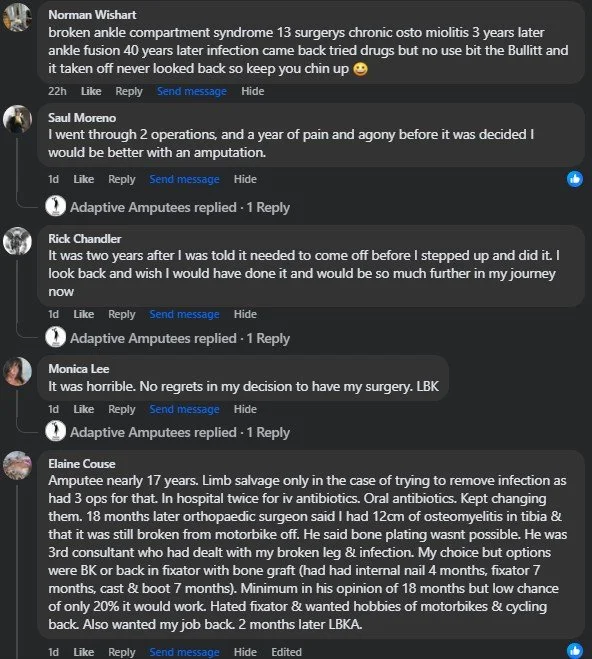
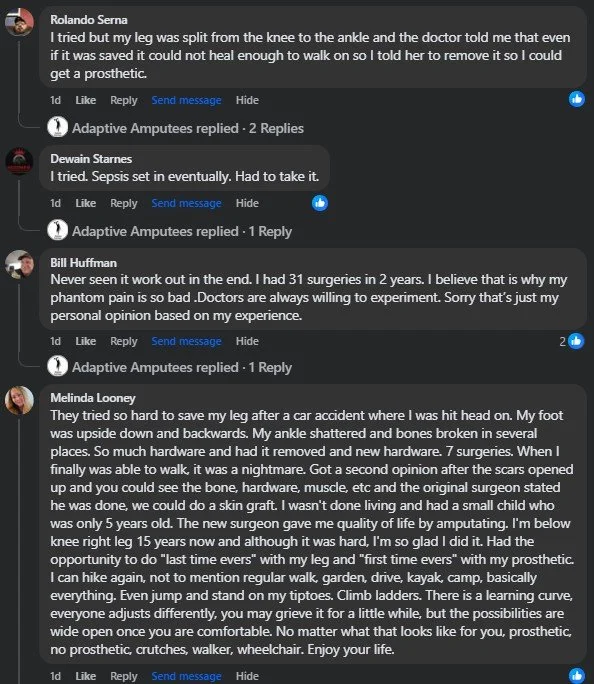
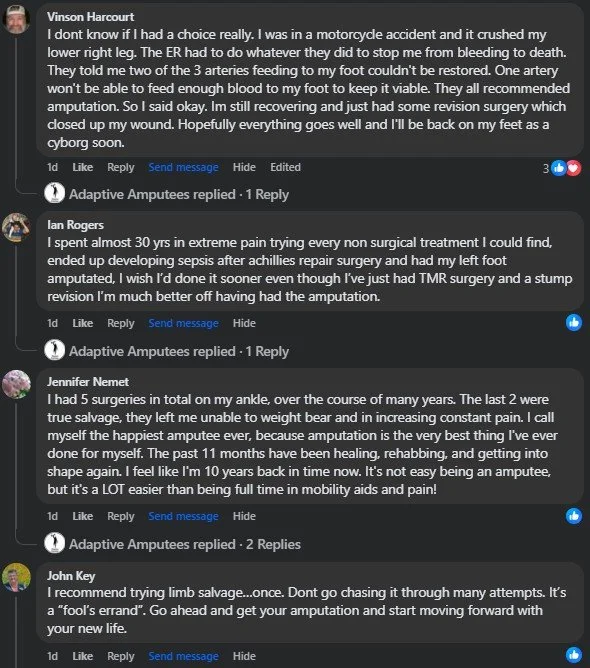
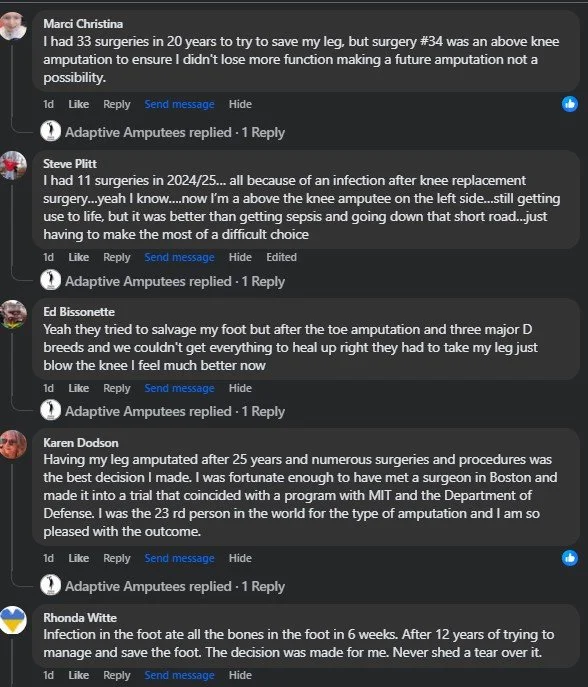
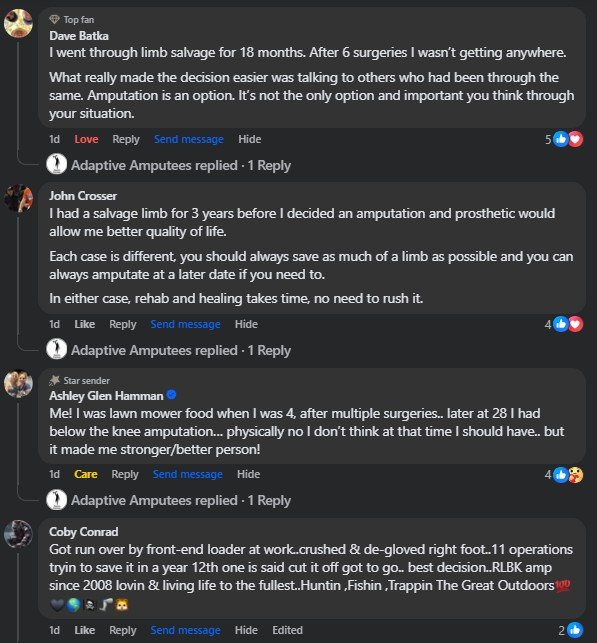
Some people tried limb salvage for years, going through surgery after surgery, only to feel relief once they finally chose amputation.
Some felt uncertain until the day after surgery, when pain and complications began to ease.
Some wished they had chosen amputation sooner.
Others needed time to mentally adjust but found independence and stability once they got their prosthesis.
Real stories remind us that outcomes vary, but many people do find peace and progress when the decision aligns with their needs and lifestyle.
What Life Looks Like After the Decision
Recovery varies from person to person. It generally includes:
Wound healing
Physical therapy
Early mobility training
Gradual prosthetic evaluations
Adjustments as your limb shape changes
Learning balance, gait, and confidence
Building routines that support long-term independence
The first prosthesis is rarely the final one. As your body adapts, your team adapts with you. Many people discover that mobility and comfort improve steadily over time, especially with strong follow-up care.
Making a Confident Decision
Confidence doesn’t mean removing all uncertainty. Confidence comes from gathering information, being supported, and choosing what aligns with your life.
Take the time you need. Ask the hard questions. Listen to your body and your instincts. You deserve clarity, compassion, and a plan that supports your future.
gather multiple opinions.
bring a support person to appointments.
Keep a notebook or pain log to track symptoms and functional limitations.
Conclusion
I truly hope this post was helpful. this is a heavy decision that will change your life. Please use the resources provided and lean on your community. No matter what decision you make that is what is right for you at the time. My parents had to decide for me. They chose to amputate below my knee being told I would “most likely become an above-knee in the future”. I have remained a below knee for 30 years so far! The decision wasn’t mine to make but it definitely changed my life, for the better!
I asked on Facebook:
Have any of you gone through limb salvage surgery? what was your experience like and how do you feel about the outcome? I hope this helps someone who's trying to make a tough decision right now. [Full Post here]