Prosthetic Suspension Systems: Pin Lock vs. Suction vs. Elevated Vacuum
Prosthetic suspension systems are the methods used to hold a prosthetic limb securely onto the body. The three most common types are pin locking systems, suction suspension, and elevated vacuum. Each system can affect comfort, skin health, stability, and overall control of the prosthesis, making suspension one of the most important parts of prosthetic fit.
Introduction: Why Suspension Matters
Have you ever used a prosthesis and dealt with skin irritation or a fit that didn't feel secure? Even with the right foot and a well-fitting socket, the suspension can make or break how a prosthesis feels and functions.
There are three main suspension systems: pin/locking, suction, and elevated vacuum. Each has advantages and limitations, and what works well for one person may not work well for another.
This post breaks down the pros and cons of each system so you can better understand your options and advocate for the suspension that works best for you with your prosthetist.
I have personally tried all three. I've also tried a thigh corset, which isn't commonly used for below-knee amputees. I have always gone back to pin and lock, but that's just what has worked best for me.
I recommend trying the suspension options your prosthetist thinks are appropriate for you. You may find that one feels more secure, comfortable, or controllable than another.
The Pin/Locking System
The pin/locking system uses a liner with a locking pin attached to the bottom. The pin slides into a shuttle lock at the bottom of the socket and secures the prosthesis in place, often with audible clicks that let you know the pin is engaging. A button on the lock mechanism releases the pin when you're ready to remove the prosthesis.
Pros
Ease of Donning: Quick and relatively simple to put on, especially compared with some suspension systems that require creating and maintaining a seal.
Security: Provides a clear, audible, and tactile locking sensation that many users find reassuring.
Minimal Knee Interference: Usually creates less bulk around the knee than some other suspension systems, which can make bending the knee easier.
This has been my biggest complaint with other suspension systems. I have limited range of motion in my knee, so I don't like anything making that more difficult.
Cost/Maintenance: Generally a straightforward suspension system with relatively few components.
Cons
Pistoning: Some users experience movement of the residual limb up and down inside the socket, known as pistoning. This can contribute to discomfort or skin irritation.
This is the most common complaint I hear from patients.
Distal Loading: The locking mechanism can place more of the suspension force toward the end, or distal portion, of the residual limb.
Best Suited For: People who prioritize a simple, easy-to-use suspension system and those who find pin locking comfortable and secure.
Traditional Suction Suspension (Skin-to-Socket Contact)
Traditional suction suspension uses a sleeve or seal to create a vacuum between the residual limb and the socket. When you put the prosthesis on, air is pushed out through a valve at the bottom of the socket. The resulting negative pressure helps hold the residual limb securely against the socket wall and can provide a very firm connection between the limb and prosthesis.
Pros
Less Pistoning: Can provide less movement between the residual limb and socket compared with a traditional pin-locking system.
I absolutely loved this firm-fit feeling. I have never felt something more secure!
Proprioception: Many users describe a more connected or natural feeling because there can be less movement between the residual limb and socket.
Stable Connection: When the seal and socket fit are working well, suction can provide a very secure connection.
Cons
Donning Difficulty: Requires more skill and technique than some other systems to create and maintain the seal.
Fit is Crucial: The seal can be lost if the limb volume changes significantly or if the sleeve is damaged.
I always got holes in my sealing sleeve, which would immediately break the seal and make my leg feel completely disconnected.
Hygiene/Moisture: Clean skin and a clean socket are important for maintaining an effective seal, and the enclosed system can be challenging when you're dealing with sweat and moisture.
Best Suited For: People who want a very secure, connected feeling and whose residual-limb volume and lifestyle allow them to maintain a reliable seal.
Elevated Vacuum (Active/Pumped Suspension)
Elevated vacuum suspension uses a pump, which can be electronic, mechanical, or passive, to actively remove air from the socket and maintain negative pressure. The goal is to maintain close contact between the residual limb and socket and reduce movement inside the socket.
Pros
Reduced Pistoning: Can significantly reduce movement between the residual limb and socket when the system is properly fitted and functioning.
Limb Volume Management: Some people find elevated vacuum helpful for managing changes in residual-limb volume and maintaining a consistent connection with the socket.
High Activity: Can be a good option for people who need a secure connection during demanding or dynamic activities.
Cons
Complexity & Cost: More components can mean a higher initial cost and potentially more maintenance or repairs.
Noise/Weight: Depending on the system, pumps and other components can add some noise or weight, although newer systems continue to improve.
I tried one of these when I was in high school. I was mortified by the noise of my prosthesis “going off” during quiet moments in the classroom.
Best Suited For: People who want to minimize movement inside the socket and who are able to manage the additional equipment and maintenance that may come with an elevated vacuum system.
The Takeaway: Finding Your Perfect Match
I really encourage you to discuss your daily activities and goals with your prosthetist. There is no one “best” suspension system, only the system that works best for you.
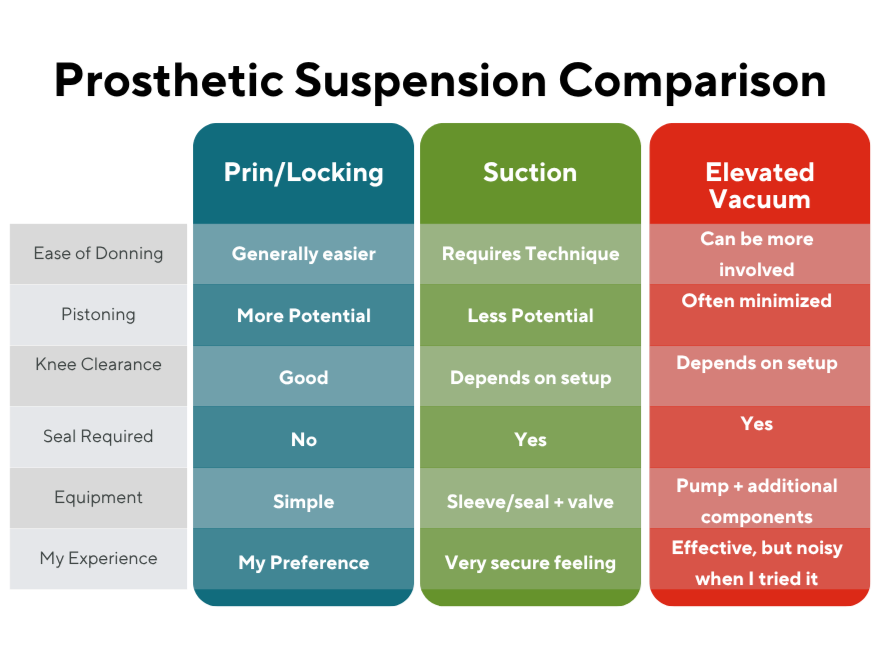
Quick comparison: Pin/locking suspension is generally simple to don and doesn't require a seal, but it can allow more pistoning. Suction suspension can provide a very secure, connected feeling but requires maintaining a good seal. Elevated vacuum can minimize movement inside the socket, but it may involve additional equipment and maintenance. The best option depends on your residual limb, activity level, comfort, and what works for you.