If you've started researching amputation, you've probably come across terms like BKA, AKA, transtibial, transfemoral, knee disarticulation, and hip disarticulation.
These terms describe where the amputation occurred. The level affects which bones and joints remain, which can influence prosthetic design, rehabilitation, and mobility.
I'm a below-knee amputee and have also worked professionally in prosthetics, including patient care, research, and prosthetic design and fabrication. Here's a breakdown of the major lower-limb amputation levels and what they mean.
What is an amputation level?
An amputation level describes where the limb was removed.
For a leg amputation, this can range from part of the foot to the hip or pelvis. The level determines which joints, bones, and muscles remain, which affects prosthetic design and mobility.
The major lower-limb amputation levels
From the foot upward, the major levels include:
Toe or partial-foot amputation
Ankle disarticulation, including a Syme amputation
Below-knee or transtibial amputation
Knee disarticulation
Above-knee or transfemoral amputation
Hip disarticulation
Hemipelvectomy
Medical sources use slightly different terminology when grouping these levels, but the basic anatomy is the same.
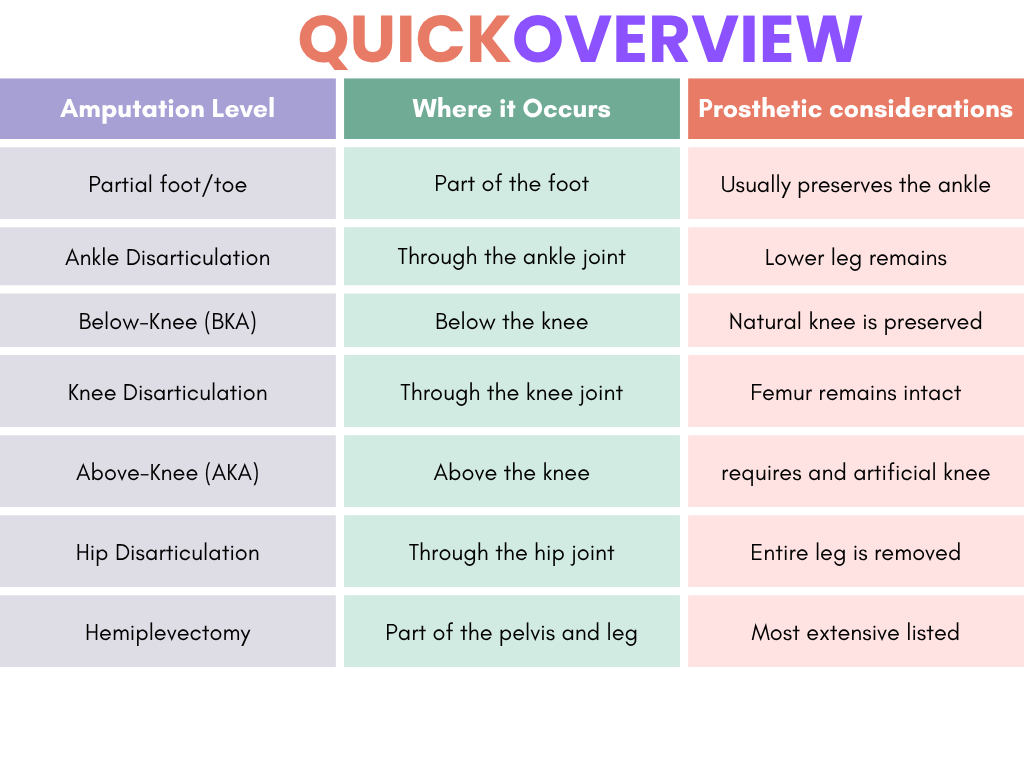
Want more detail? Below, I break down each level, including what remains anatomically, how it affects prosthetic design, and what that can mean for mobility.
Partial-foot and toe amputations
Not every leg amputation involves losing the entire foot or a large portion of the leg.
A person may have one or more toes amputated, part of the foot removed, or an amputation farther back through the foot.
There are several types of partial-foot amputation, including transmetatarsal, Lisfranc, and Chopart amputations.
The exact level matters because even a relatively small difference in where the foot ends can change how someone bears weight and walks.
Some people with partial-foot amputations may use a specialized shoe, insert, or prosthetic device rather than what most people picture as a traditional prosthetic leg.
Ankle disarticulation and Syme amputation
An ankle disarticulation removes the foot through the ankle joint rather than cutting through the tibia and fibula farther up the leg.
A Syme amputation is a type of ankle disarticulation in which the heel pad is generally preserved and repositioned to the end of the residual limb.
One advantage of this level is that the heel pad can allow for some weight bearing through the end of the residual limb after healing.
The shape and size of the residual limb can also make prosthetic fitting different from a typical below-knee amputation.
Below-knee amputation, or BKA
A below-knee amputation (BKA) is also called a transtibial amputation. The amputation occurs through the lower leg, below the knee joint.
The tibia and fibula are the two bones of the lower leg, and the natural knee joint is preserved.
This is my level. I've been a below-knee amputee for about 30 years. I was born with clubfoot and tibia hemimelia, and had my amputation at about 4½ years old. My anatomy and experience are different from someone who became a BKA later in life, but anatomically, I still have a knee.
A below-knee prosthesis uses the biological knee rather than replacing it with an artificial one. It typically includes a socket, suspension system, lower-leg components, and a prosthetic foot.
Preserving the knee can provide important mechanical advantages for prosthetic walking, although factors like residual-limb shape, strength, skin, suspension, alignment, and prosthetic fit still matter.
What does having the knee preserved mean?
In general, preserving the knee gives a prosthetic user an important biological joint to work with.
An above-knee prosthesis has to provide an artificial knee. A below-knee prosthesis doesn't.
That doesn't mean being a below-knee amputee is easy. It isn't. Socket fit, skin issues, suspension, residual-limb changes, alignment, component selection, strength, balance, and plenty of other factors can affect how well someone walks.
But there is a significant mechanical difference between having your biological knee and needing a prosthetic one.
Knee disarticulation
A knee disarticulation, sometimes called a through-knee amputation, occurs through the knee joint.
Instead of cutting through the femur above the knee, the lower leg is separated from the femur at the knee joint itself. This preserves the femur and its full length.
This is different from a BKA because the knee joint itself is no longer intact.
It's also different from a traditional above-knee amputation because the femur isn't cut through.
This level has some unique prosthetic considerations, including the shape of the residual limb and the way the prosthesis is designed around the end of the femur.
Above-knee amputation, or AKA
An above-knee amputation (AKA) is also called a transfemoral amputation. The amputation occurs through the femur, above the knee, so the natural knee joint is no longer present.
An above-knee prosthesis therefore needs to provide an artificial knee in addition to the lower-leg and foot components. Controlling an artificial knee while managing the socket and rest of the prosthesis generally makes prosthetic walking more mechanically demanding than with a transtibial amputation.
Walking with a prosthesis also generally requires more energy as the amputation level moves higher.
Hip disarticulation
A hip disarticulation is much higher on the body.
Instead of cutting through the femur, the leg is removed at the hip joint. The femur is therefore no longer present.
A prosthesis for someone with a hip disarticulation needs to account for an artificial hip joint, knee joint, lower leg, and foot.
A hip disarticulation removes the leg through the hip joint, so the femur is no longer present.
The prosthesis may need to provide an artificial hip, knee, lower leg, and foot. The loss of additional joints and muscles also makes prosthetic walking more complex and physically demanding.
The difference isn't just the number of components, either. The person has lost additional joints and muscles that would normally contribute to controlling the leg.
That can make prosthetic walking significantly more complex and physically demanding.
Hemipelvectomy
A hemipelvectomy goes beyond the hip.
In an external hemipelvectomy, the leg and part of the pelvis are removed. This is one of the most proximal levels of lower-limb amputation.
Because even more of the body's normal anatomy is involved, the prosthetic and rehabilitation considerations are substantially different from those for a below-knee or above-knee amputation.
This is also a relatively uncommon level of amputation.
Amputation level doesn't tell the whole story
The level of an amputation tells us where the limb was removed and which major joints and bones remain. But it doesn't tell us everything about someone's anatomy, function, or experience.
I'm a good example. I have a below-knee amputation, so I have a biological knee. But I was born without a tibia and am missing much of the anatomy and connective tissue that would normally support and stabilize that knee. My knee doesn't fully bend and is internally rotated.
Two people with the same amputation level can also have very different residual-limb length and shape, muscle strength, joint mobility, sensation, surgical history, prosthetic fit, rehabilitation, and personal goals.
There are real mechanical differences between levels. Preserving the knee, for example, generally provides advantages for prosthetic walking compared with an amputation where the knee is removed. But that doesn't determine what an individual person can do.
Amputation level is one part of the picture, not the whole picture.
If you're facing an amputation, ask about your specific level
If you're facing an amputation, ask your medical team:
Where exactly will the amputation occur?
Will the knee joint be preserved?
How much residual limb length is expected?
What will weight bearing look like?
What type of prosthesis might eventually be appropriate?
What will rehabilitation involve?
What mobility equipment will you use while healing?
What should you expect during the prosthetic fitting process?
And don't be afraid to ask your prosthetist questions too.
I've written more about preparing for prosthetist appointments and the questions I think amputees should ask in my [Prosthetist Appointment Checklist].
You can also read my [New Amputee Guide] for practical advice from people who have actually lived with limb loss.
The bottom line
Your amputation level affects the joints you retain, the prosthesis you use, and the mechanics of prosthetic mobility.
But the level doesn't tell you everything about the person living with it. Residual-limb anatomy, strength, mobility, prosthetic fit, rehabilitation, and individual goals all matter.
Your amputation level is part of your story. It isn't the whole story.
FAQs
-
In general, preserving more of the limb and retaining important joints such as the knee can provide mechanical advantages for prosthetic walking. But there isn't one amputation level that guarantees an easy or difficult outcome.
Residual limb length, muscle strength, joint mobility, overall health, prosthetic fit, rehabilitation, and a person's goals all matter too.
A below-knee amputation generally has some mechanical advantages over an above-knee amputation because the biological knee is preserved. But that doesn't mean every below-knee amputee will have an easy time walking, or that someone with an above-knee or higher-level amputation can't become highly mobile and active.
-
A below-knee amputation (BKA) removes the leg below the knee, so the biological knee is preserved. An above-knee amputation (AKA) removes the leg above the knee, so the prosthesis needs an artificial knee. Because of this, the two levels involve different prosthetic designs, walking mechanics, and physical demands.
-
Many people can walk very well with a prosthesis after a leg amputation, but there isn't one definition of “normal” walking. How someone walks depends on their amputation level, residual limb, strength, joint mobility, prosthetic fit, rehabilitation, and other individual factors. Some people walk, run, hike, play sports, and stay highly active after limb loss.
-
Yes. The level of amputation determines what joints and anatomy are available to the prosthesis, which affects its design. For example, a below-knee prosthesis can use the person's biological knee, while an above-knee prosthesis needs an artificial knee. Other factors, including residual limb shape and length, activity level, and individual needs, also influence the prosthesis you use.
Where to go next
🦿 New to amputation?
Read the New Amputee Guide →
💰 Wondering what your prosthesis will cost?
Read How Much Does a Prosthetic Leg Cost? →
🧑⚕️ Getting ready for your prosthetist appointment?
Use the Prosthetic Appointment Checklist →
🦿 Already have a prosthesis?
Learn about suspension systems →