Types of Arm Amputation: Levels, Differences, and What They Mean
If you've started researching upper-limb amputation, you've probably come across terms like transradial, transhumeral, wrist disarticulation, elbow disarticulation, and shoulder disarticulation.
These terms describe where the amputation occurred, which determines what bones, joints, muscles, and other anatomy remain. That can affect prosthetic design, rehabilitation, function, and everyday life.
I've spent much of my life as an amputee and have also worked professionally in prosthetics and orthotics. My own amputation is lower-limb, so I don't have the lived experience of upper-limb amputation, but I do have experience with the prosthetic and biomechanical side.
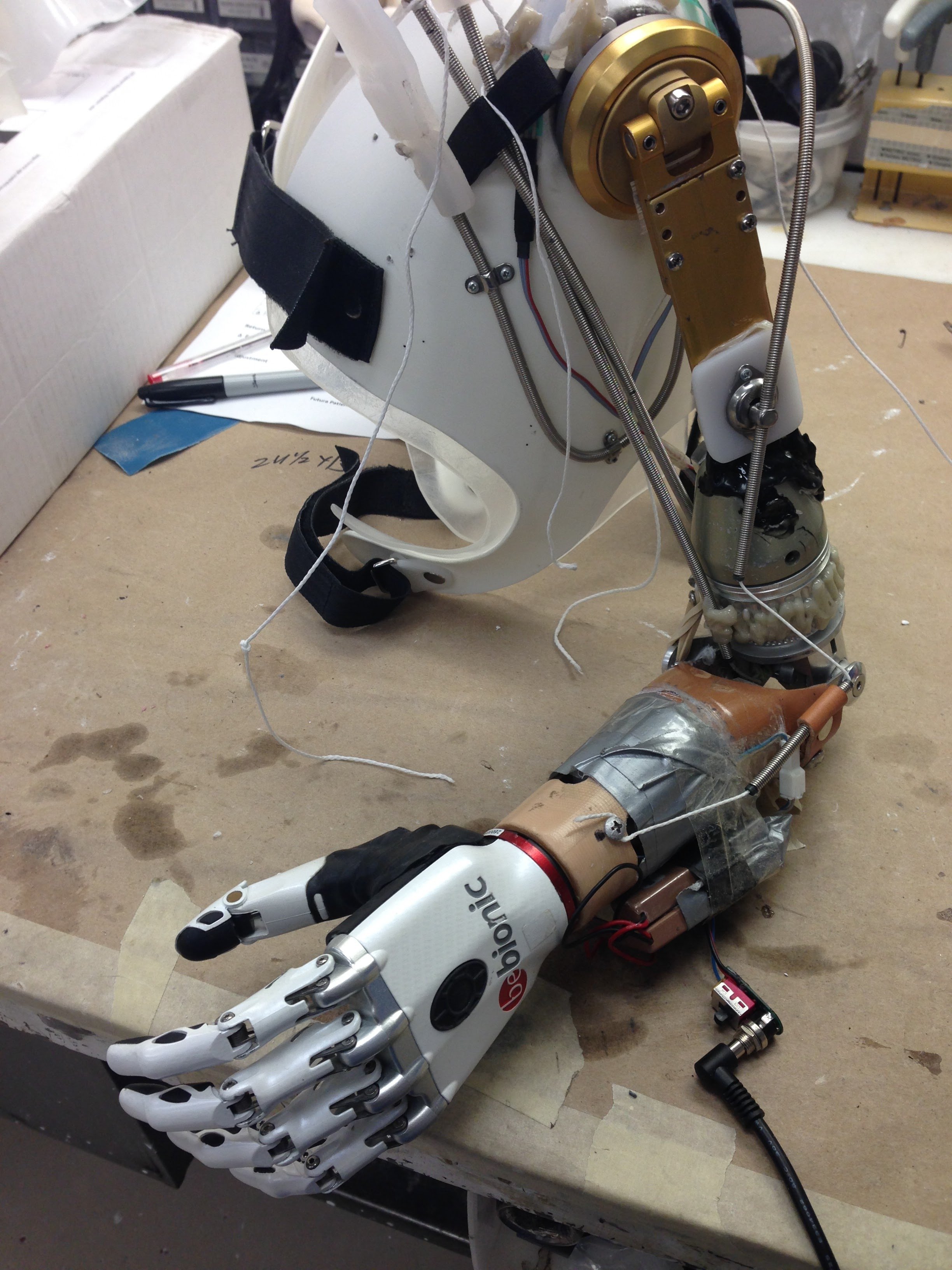
This was a prosthetic arm I worked on for a patient in Chicago back in 2016!
What is an upper-limb amputation level?
An amputation level describes where the limb was surgically removed.
For an upper-limb amputation, that could mean removing part of a finger, part of the hand, the hand through the wrist, part of the forearm, the arm above the elbow, or the entire arm at the shoulder.
The level matters because it determines which bones, joints, muscles, and other anatomy remain.
For example, someone with a transradial, or below-elbow, amputation still has their natural elbow. Someone with a transhumeral, or above-elbow, amputation does not.
That difference has major implications for how a prosthesis can be designed and controlled.
But, just like with lower-limb amputation, the amputation level doesn't tell you everything about a person's abilities or experience.
Two people can have the same amputation level and have very different residual limbs, strength, sensation, prosthetic needs, and goals.
The different upper-limb amputation levels
From the hand upward, the major levels include:
Finger or partial-hand amputation
Wrist disarticulation
Transradial or below-elbow amputation
Elbow disarticulation
Transhumeral or above-elbow amputation
Shoulder disarticulation
Forequarter amputation
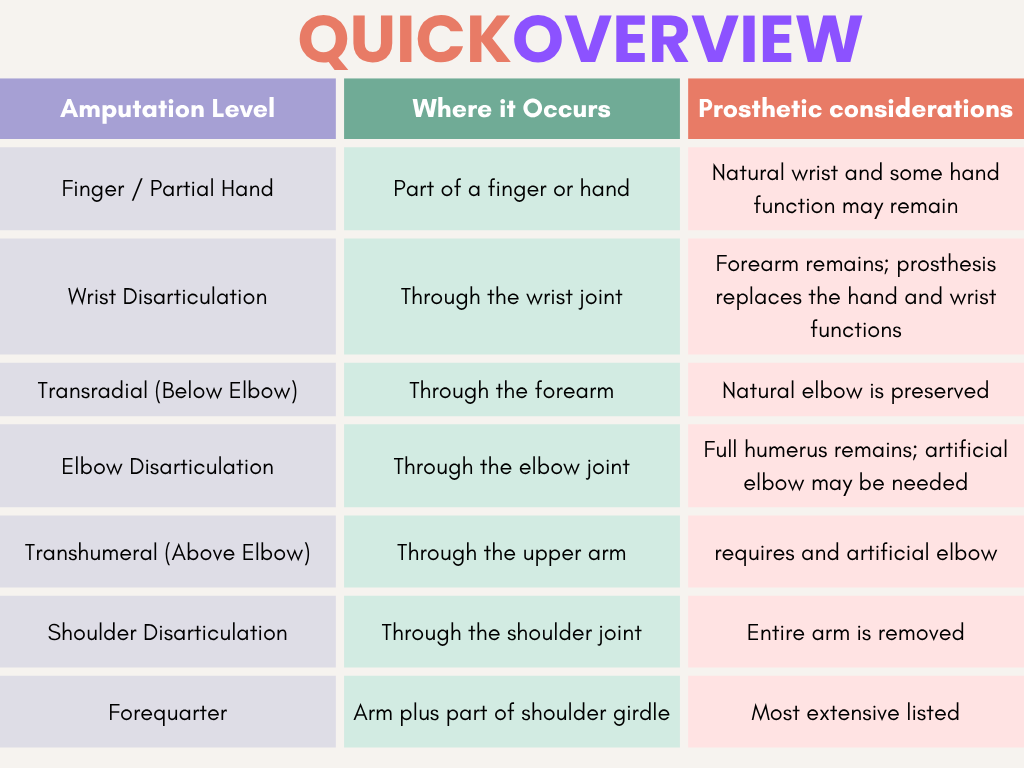
Medical sources may group some of these levels slightly differently, particularly when discussing partial-hand amputations, but these are the major terms you'll commonly encounter.
Want more detail? Below, I'll break down each level, including what anatomy remains and how the level can affect prosthetic considerations.
Finger & Partial-Hand Amputation
Not every upper-limb amputation involves losing the entire hand or arm.
Someone may have one finger amputated, several fingers amputated, part of the palm removed, or a larger portion of the hand removed while still retaining the wrist.
Because partial-hand amputations can vary so much, the exact anatomy that remains matters. The remaining fingers, thumb, wrist, and amount of hand remaining can all affect function and prosthetic or adaptive options.
Some people use specialized partial-hand or finger prostheses. Others may not use a prosthesis and instead adapt how they perform certain tasks.
Why the thumb matters
The thumb plays an important role in grasping and pinching. Losing one or more fingers while retaining a functional thumb can result in very different options than losing the thumb as well.
"Partial hand" doesn't tell you the whole story. The exact anatomy that remains matters.
Wrist Disarticulation
A wrist disarticulation occurs through the wrist joint.
Unlike a transradial amputation, where the radius and ulna are cut through the forearm, a wrist disarticulation separates the hand from the forearm through the wrist. The forearm bones remain.
The amount of forearm that remains can be an important consideration for prosthetic fitting and control.
A person with a wrist disarticulation generally retains forearm rotation, including pronation and supination, but the natural wrist joint itself is no longer present.
That means a prosthesis may need to provide some of the functions that the biological wrist previously performed.
Depending on the person's needs, prosthetic options can include a prosthetic hand, hook, or specialized terminal device.
Wrist disarticulation is also different from a transradial amputation because the forearm bones remain at their full length.
That distinction can affect the shape of the prosthetic socket, the available space for components, and how the prosthesis is designed.
Transradial Amputation, or Below-Elbow Amputation
A transradial amputation occurs through the forearm below the elbow.
It's also commonly called a below-elbow amputation, or BE.
The radius and ulna are the two bones of the forearm, and the amputation occurs through those bones.
Most importantly, the natural elbow joint remains.
That elbow makes a huge difference.
Someone with a transradial amputation can still use their biological elbow to position their prosthesis. Depending on the length of the residual limb, they may also retain some ability to rotate the forearm.
The amount of residual limb remaining can vary significantly. Transradial amputations are sometimes described as long, medium, or short depending on how much of the forearm remains.
And that length matters.
A longer residual limb generally provides more biological anatomy to work with, including more potential muscle function and leverage. A shorter residual limb may present different prosthetic fitting and control considerations.
That doesn't mean one person's experience is automatically better or worse.
It means the anatomy is different, and the prosthesis has to work with the anatomy that person has.
A transradial prosthesis might include a socket, suspension system, forearm components, a wrist unit, and a terminal device such as a hand or hook. Depending on the person's needs, the system may be passive, body-powered, externally powered such as myoelectric, or another configuration.
Elbow Disarticulation
An elbow disarticulation occurs through the elbow joint.
Instead of cutting through the humerus above the elbow, the forearm is separated from the upper arm through the elbow joint itself.
The humerus remains intact.
This makes elbow disarticulation different from both a transradial and a transhumeral amputation.
The natural elbow joint is no longer present, but the full length of the humerus remains.
That creates some unique prosthetic considerations.
A prosthesis for someone with an elbow disarticulation needs to provide an artificial elbow function, along with whatever other components are needed below the elbow.
The shape and length of the residual limb also influence the design.
Elbow disarticulation prostheses can use different combinations of control systems and components. Body-powered and externally powered systems can both be used depending on the individual and their goals.
Transhumeral Amputation, or Above-Elbow Amputation
A transhumeral amputation occurs through the upper arm, above the elbow.
It's also commonly called an above-elbow amputation, or AE.
The humerus is the long bone of the upper arm, and the amputation occurs through it.
A transhumeral amputation occurs through the upper arm, above the elbow. It's also called an above-elbow amputation, or AE.
The natural elbow is no longer present, so a prosthesis may need to provide an artificial elbow in addition to the wrist and terminal device. The length of the residual limb also affects prosthetic fitting and control.
Prosthetic systems at this level can be body-powered, externally powered, or hybrid.
But, just like with lower-limb amputation, the level of amputation doesn't tell you what someone is capable of doing.
It tells you what anatomy the prosthetic system has to work with.
Shoulder Disarticulation
A shoulder disarticulation occurs through the shoulder joint.
The entire arm is removed, including the humerus, while the shoulder girdle remains.
This is a much higher level of upper-limb amputation than transhumeral or elbow disarticulation.
Because the arm and its joints are no longer present, a prosthesis at this level may need to provide several functions, potentially including an artificial shoulder, elbow, wrist, and terminal device.
That makes the prosthetic system substantially different from one used after a transradial amputation.
There are also different considerations when it comes to suspension, weight, comfort, and heat because a larger portion of the body may be involved in supporting the prosthesis.
Merck notes that weight distribution, heat dissipation, and comfort are particularly important considerations for shoulder disarticulation and higher-level prostheses.
And again, there is no single prosthetic setup that works for everyone at this level.
The person's anatomy, goals, available muscle control, occupation, activities, comfort, and preferences all matter.
Forequarter Amputation
A forequarter amputation is one of the proximal levels of upper-limb amputation.
Unlike a shoulder disarticulation, which removes the arm through the shoulder joint, a forequarter amputation also involves part of the shoulder girdle, including portions of the scapula and clavicle.
This makes it anatomically different from a shoulder disarticulation.
Forequarter amputations are relatively uncommon, and the prosthetic and rehabilitation considerations are substantially different from those associated with lower-level upper-limb amputations.
Because the person's anatomy is different, prosthetic fitting, suspension, control, weight distribution, and comfort all require careful consideration.
Amputation Level Doesn't Tell the Whole Story
The level of an amputation tells us where the limb was removed and which major joints and bones remain. But it doesn't tell us everything about someone's experience.
Two people with the same amputation level can have very different:
Residual-limb length and shape
Muscle strength
Joint mobility
Sensation
Nerve involvement
Skin condition
Surgical history
Prosthetic fit and components
Activities and personal goals
For example, two people with transradial amputations may have very different residual-limb lengths and muscle function, which can affect prosthetic fitting and control.
The amputation level is a starting point, not the whole story.
If You're Facing an Upper-Limb Amputation
If you're reading this because you or someone you love is facing an amputation, you may have a lot of questions about what comes next.
It's completely reasonable to ask questions before surgery.
Depending on your situation, you might ask your medical team:
Where exactly will the amputation occur?
What bones and joints will remain?
How much residual limb length is expected?
What muscles and movement are expected to remain?
What changes in sensation should I expect?
What will recovery and rehabilitation involve?
What prosthetic options might eventually be appropriate?
When would you meet with a prosthetist?
What should you expect during the prosthetic fitting process?
What other adaptive equipment might be useful during recovery?
What questions should you ask about insurance and prosthetic coverage?
You don't have to understand every prosthetic term before surgery.
And you don't need to know what kind of prosthesis you want before you've even had time to recover.
Your anatomy, goals, and needs will help shape those decisions over time.
What Comes Next?
Once you understand the amputation level, the next question is often: What kind of prosthesis can I use?
That's the focus of my next article, which covers passive, body-powered, myoelectric, hybrid, and activity-specific upper-limb prostheses. Stay Tuned!